

India’s fast bowling workload management: how BCCI uses sports science to protect next-gen speedsters
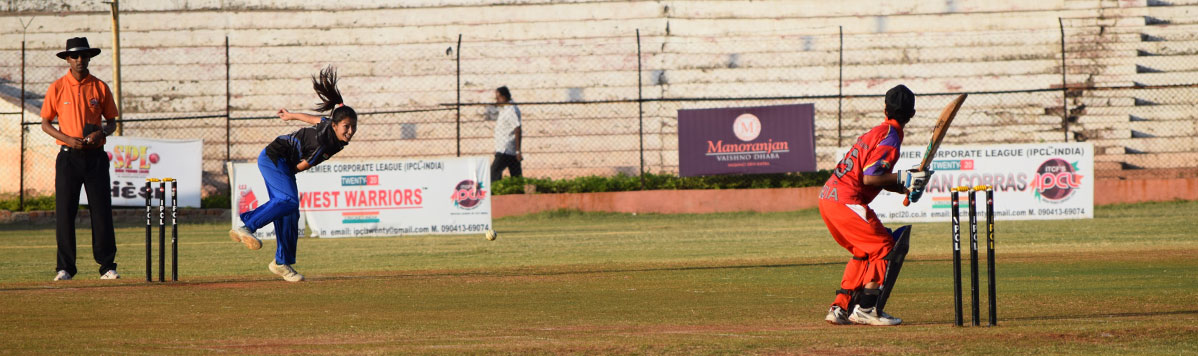
Nothing captures the imagination of cricket fans quite like a bowler running in from the boundary ropes and sending a leather projectile hurtling toward a batter at over 150 kilometers per hour. For decades, India yearned for such raw pace, relying instead on spin and medium-pace swing. Today, the country boasts an embarrassment of fast-bowling riches, but this evolution has come with a steep physiological price tag. Bowling fast is an inherently unnatural act, putting immense strain on the human spine, knees, and ankles. To prevent its prized assets from breaking down, the national cricket board has turned to cutting-edge technology, transforming how fast bowlers are managed, trained, and rested.
The physical toll of raw pace: why modern speedsters break down
To understand the complexity of Indian fast bowlers workload management, one must first look at the sheer physical forces involved in modern fast bowling. When a bowler lands their front foot at the crease, the force traveling up through their leg to the lower back can reach up to ten times their body weight. Over an extended season, this repetitive stress can cause minor micro-fractures in the vertebrae, eventually leading to debilitating lumbar stress fractures.
In the past, these injuries were often treated as an inevitable hazard of the profession, forcing players into long periods of forced rest without addressing the root cause. Biomechanical researchers have identified several primary physical triggers that accelerate spinal fatigue and muscular failure in elite athletes:
- Excessive hyper-extension: leaning too far backward during the release phase, which compresses the lumbar discs under high velocity.
- Shoulder-hip misalignment: executing a mixed bowling action where the hips face one direction and the shoulders face another at the point of delivery.
- Rapid workload spikes: sudden increases in the number of deliveries bowled over a short period without a proper physical foundation.
By identifying these critical risk factors early in a bowler’s career, coaches can adjust training regimes to prevent long-term damage. This preventative approach is particularly crucial for younger athletes whose skeletal structures are still developing and adapting to the extreme demands of professional sport.
Microchips and metrics: how the NCA tracks physical strain
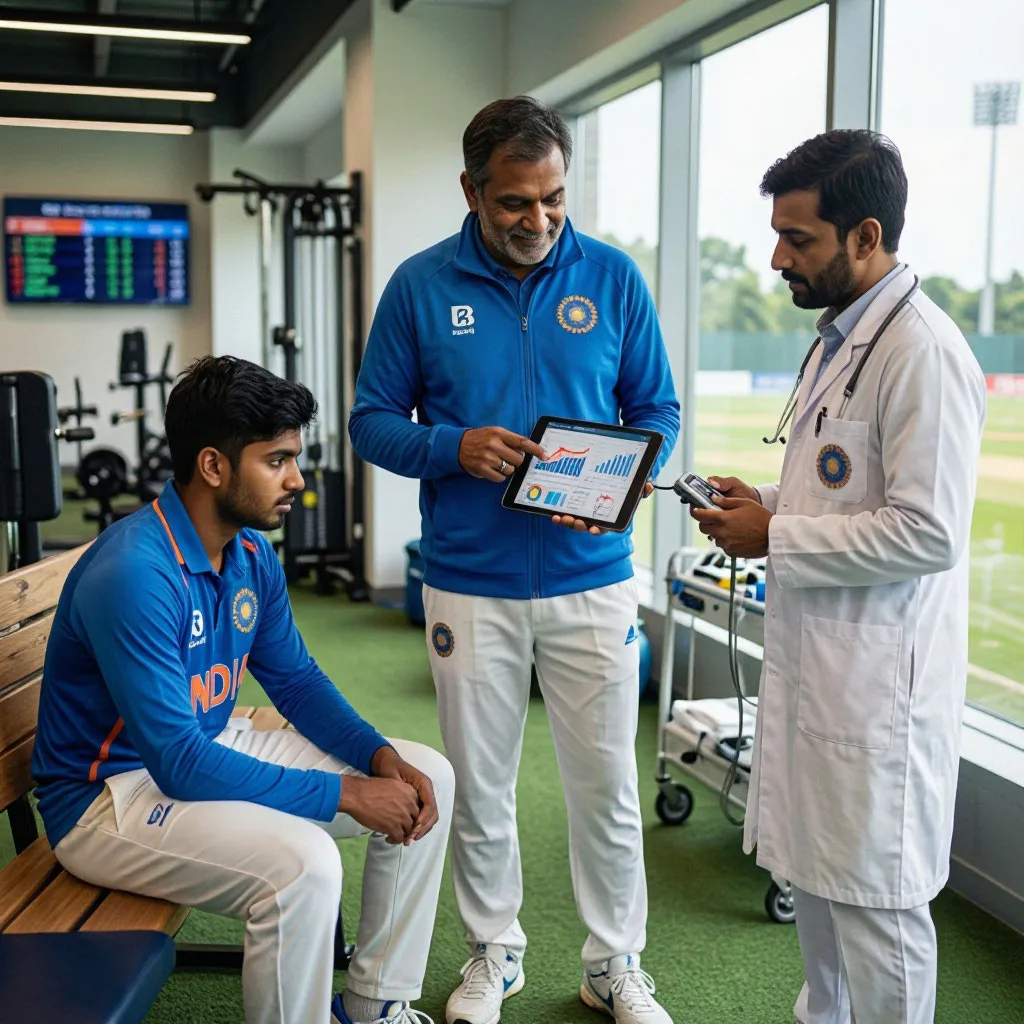
The nerve center of this scientific revolution is located in Bengaluru, where the National Cricket Academy serves as the high-tech laboratory for player rehabilitation and monitoring. Under the umbrella of BCCI sports science NCA specialists use a sophisticated network of wearable sensors, high-speed cameras, and mathematical algorithms to build a digital twin of every contracted bowler.
During training sessions and domestic matches, bowlers wear small, lightweight GPS units tucked into specialized vests between their shoulder blades. These devices measure physical exertion in real-time, sending data directly to analysts on the sidelines who track several key indicators of fatigue.
The collected physical performance data allows sports scientists to monitor individual thresholds and intervene before a player reaches a danger zone:
| Performance metric | Measurement technology | Target threshold | Injury prevention benefit |
|---|---|---|---|
| Player load index | Tri-axial accelerometers | Player-specific baseline | Prevents general systemic fatigue and soft tissue strains |
| Peak delivery force | Gyroscopes and IMU sensors | Under 9g of landing force | Reduces impact stress on the knees and lower back |
| High-speed running | GPS satellite tracking | Restricted based on match day | Ensures adequate cardiovascular recovery between spells |
| Release angle consistency | 3D motion capture cameras | Less than 5 degrees of variance | Detects subtle mechanical changes caused by onset fatigue |
By evaluating these precise measurements, the medical team can accurately predict when a bowler is approaching their physical limit. This scientific approach removes the guesswork from coaching, allowing teams to make informed decisions about when to rest a player rather than waiting for an injury to occur on the field.
Managing the elite and the emerging: Jasprit Bumrah and Mayank Yadav
The practical application of this scientific framework is best seen in how the board manages its premier superstars alongside its most exciting young prospects. The success of Jasprit Bumrah bowling management serves as a masterclass in long-term physical conservation. After suffering a major back injury that kept him out of action for nearly a year, his return was meticulously planned by sports scientists. His bowling volume was slowly increased in controlled environments, ensuring his unique, high-stress action did not re-aggravate his lumbar spine.
At the other end of the spectrum is the management of emerging speed merchants who have burst onto the scene with astonishing pace. The latest Mayank Yadav fitness update highlights how the academy is handling young bowlers who can naturally breach the 150 kmph barrier. Instead of rushing these young prospects into continuous match play, the medical staff treats them with extreme caution, building their core strength to match their explosive output.
To ensure these young speedsters do not suffer career-threatening setbacks, the academy has established a strict set of protocols for integration into senior cricket:
- Ball-count restrictions: limiting the total number of deliveries bowled in a single week, including both practice nets and official matches.
- Mandatory recovery windows: enforcing a minimum of forty-eight hours of physical rest between high-intensity bowling spells.
- Biomechanical mapping: conducting regular 3D analysis to ensure their bowling action does not deteriorate under physical fatigue.
Following these structured development steps helps young athletes transition smoothly to the rigorous demands of international cricket. By prioritizing physical longevity over immediate match results, the system protects its most vulnerable and valuable assets during their formative years.
Building a sustainable fast bowling reservoir
This shift toward a highly scientific management system represents a fundamental change in how the sport is run in India. By focusing on physical longevity and mechanical efficiency, the administration is ensuring that the country’s fast-bowling revolution is not a temporary phase, but a sustainable foundation.
As technology continues to evolve, the integration of artificial intelligence and predictive modeling will likely make injury prevention even more precise. By keeping its best players on the field and its young talents healthy, India is setting a new global standard for athletic care in professional cricket.